
A propaganda film of Nazi Germany “Hitler the Liberator,” created for the residents of the occupied territories of the USSR, was discovered on the official website of the Ministry of Justice of Russia. The video recording contains glorification of Adolf Hitler, anti-Semitic theses, and calls to cooperate with the occupying power, but the Russian Ministry of Justice did not accompany it with a full historical commentary or warning.
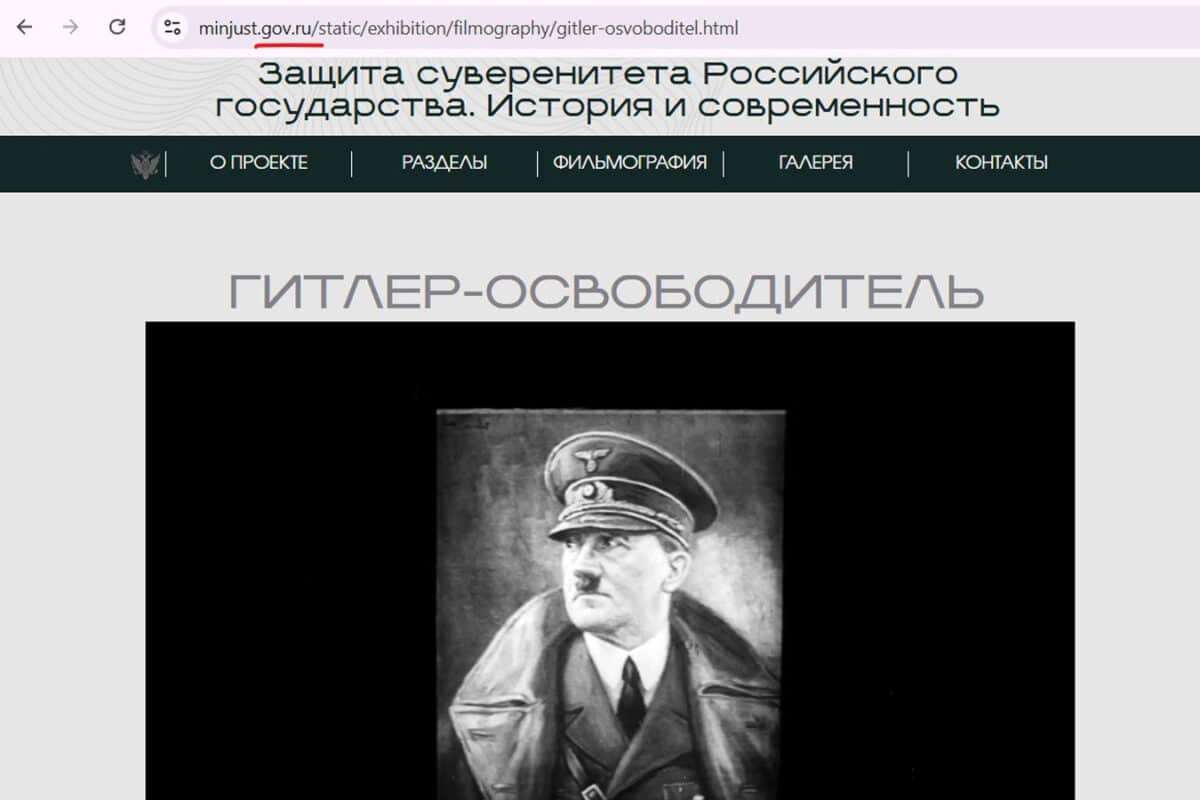
A film titled “Hitler the Liberator” has been published on the official internet resource of the Ministry of Justice of Russia. The page exists within the state online exhibition “Protection of the Sovereignty of the Russian State. History and Modernity,” and at the bottom of the site, the contacts of the Russian department itself are indicated.
A visitor on this page – https://minjust.gov.ru/static/exhibition/filmography/gitler-osvoboditel.html sees a large headline “Hitler the Liberator,” an embedded video, and a single short caption: “Film ‘Hitler the Liberator’.” There is no noticeable warning on the page that the viewer is facing a work of Nazi propaganda, no information about the authors, time of creation, target audience, and the criminal ideology that this film spread.
On July 27, 2026, screenshots of the page began to spread on social networks and media. Verification shows that it is not a fake, not a third-party mirror, and not an accidental file: the page is indeed hosted on the official domain of the Ministry of Justice of Russia and included in the filmography of the state exhibition.
What is “Hitler the Liberator”
This is not a modern documentary about World War II and not a study of the crimes of Nazi Germany. It is a propaganda film prepared during the German occupation for the ideological processing of the population of the occupied Soviet territories.
The film was supposed to convince people that the Nazi Germany’s attack on the USSR was allegedly not a war of conquest, but a “liberation” from Bolshevism. Hitler is portrayed as the person who first began the “merciless struggle” against the Soviet system and supposedly acts in the interests of the Russian people.
At the same time, the viewer is imposed with an anti-Semitic worldview characteristic of Nazi ideology. The film talks about Hitler’s struggle against the so-called “world Jewry,” “predatory capital,” and “deceitful hypocritical democracy.” Anglo-American states are presented as forces that allegedly forced Germany to fight.
Thus, the film combines several main directions of Third Reich propaganda:
- demonization of Jews;
- justification of Germany’s attack on the USSR;
- presentation of occupation as “liberation”;
- calls for cooperation with the invaders;
- creating the illusion of peaceful and prosperous life under Nazi rule.
The video sequence shows portraits of Hitler, the destruction of Soviet symbols, the work of artisans, markets, laboratories, road construction, agricultural work, schools, and children. Such footage was intended to convince the population that the occupation administration was supposedly restoring normal life and creating a new order.
In reality, the Nazi occupation was accompanied by mass shootings, the destruction of Jewish communities, deportations, forced labor, hunger, and terror against the civilian population. Therefore, the image of the “liberator” was not just a historical mistake, but a deliberate lie necessary for the occupiers to suppress resistance and obtain labor force.
Call to serve the occupying power
The main goal of the film was not only to create a positive image of Hitler. The film essentially explained to the population why it should help the German administration.
Hitler is presented in it as the “liberator of the Russian people,” and helping the Nazis is the duty of a person who supposedly loves his homeland. The Soviet red star is called a symbol of “international slavery,” the destruction of which supposedly opens the way to the country’s revival.
This is a fundamentally important detail. The Ministry of Justice of Russia did not place separate fragments of chronicles within the framework of a historian’s lecture, but a full-fledged propaganda product, the purpose of which was to incline the residents of the occupied territories to loyalty and cooperation with the regime that carried out the Holocaust and the mass destruction of Soviet citizens.
Why the film ended up on the Ministry of Justice’s website
The Nazi film is included in the online exhibition titled “Protection of the Sovereignty of the Russian State. History and Modernity”.
The project description states that it is dedicated to attempts to violate Russian sovereignty from outside and the need to counteract such actions taking into account historical experience. The history of Russia in the exposition is presented as a continuous chain of foreign interference, conspiracies, propaganda, and activities of forces allegedly trying to destroy the state.
The exhibition is divided into several periods:
- XVI–XVIII centuries — “From turmoil to palace coups”;
- XIX century — “False notes of the European concert”;
- 1905–1921 years — “Era of great upheavals”;
- 1921–1945 years — “In the ring of enemies”;
- 1945–1985 years — “Through the iron curtain”;
- 1991–2000 years — “Woe to the vanquished”;
- period from 2022 — “New challenges”;
- separate section — “Register of foreign agents in faces”.
The film “Hitler the Liberator,” judging by the structure of the project, should illustrate foreign propaganda of the period 1921–1945. Therefore, to claim that the Ministry of Justice officially supports the content of the film or truly considers Hitler a liberator would be inaccurate.
However, the presence of a museum or educational purpose does not remove the main question: why did a state department place Nazi propaganda practically without context?
Not the publication, but the lack of explanations became the main scandal
Historical archives, museums, and research centers can publish Nazi films, posters, Hitler’s speeches, and other sources of the era. Studying propaganda is necessary to understand how totalitarian regimes manipulated society and prepared mass crimes.
But professional publication of such material usually includes:
- exact date and place of creation;
- information about the authors and customers;
- explanation of the target audience;
- description of the propaganda task;
- warning about anti-Semitic and misanthropic content;
- analysis of historical fakes and manipulations;
- information about the real crimes of the occupation regime.
Nothing of the sort is directly on the Ministry of Justice’s page. The visitor is offered to press the play button under the huge headline “Hitler the Liberator,” and the only caption just repeats the title of the film.
With such design, a negative attitude towards Nazi ideology has to be inferred not from the content of the page, but from the general title of the exhibition and its supposed intent.
NAnews — News of Israel notes: the absence of a separate warning about the anti-Semitic component of the film is especially dangerous. This is not just about military agitation, but about material that reproduces the Nazi myth of “world Jewry” as an enemy and justifies the fight against it.
The Ministry of Justice itself maintains a list of banned extremist materials
The situation looks especially indicative due to the functions of the Russian Ministry of Justice itself.
It is the Ministry of Justice of the Russian Federation that maintains and publishes the Federal List of Extremist Materials. The department explains that the list is formed based on court decisions that have entered into force. It includes books, articles, images, audio recordings, and videos recognized by Russian courts as extremist.
For example, the list includes a video “Hitler’s Last Speech on January 30, 1945.” The official description of the Ministry of Justice states that it glorifies Nazism and Hitler personally, justifies the idea of racial superiority and national intolerance.
Another video included in the list titled “Adolf Hitler — What We Fought For” contains swastikas, quotes from Hitler’s speeches, and the idea of reviving the German Reich based on Nazi ideology.
The registry also contains materials with anti-Semitic images, Nazi symbols, and mockery of the memory of Holocaust victims.
Against this background, an obvious contradiction arises: the department publishes a list of materials whose distribution is restricted by court decisions, but at the same time places a full-fledged propaganda film of the Third Reich without clarifying its status and without noticeable historical marking.
What Russian legislation says
Russian legislation provides for liability for propaganda or public display of Nazi attributes and symbols. In case of repeated violation after administrative punishment, criminal liability is possible.
At the same time, Article 20.3 of the Code of Administrative Offenses has an important exception. Liability does not arise when Nazi symbols are used in such a way that a negative attitude towards Nazism is formed and there are no signs of its propaganda or justification.
It is probably this exception that the Ministry of Justice could refer to: the film is included in a historical exhibition and formally should show an example of enemy propaganda.
But the problem lies in the design of the page. A negative attitude towards Nazism is not separately formulated there. There is no analysis, no warning, no condemning commentary. The user gets access to the original propaganda material, while its historical exposure remains only assumed.
Only a court can give a legal assessment of this publication. However, from a public and professional point of view, the double standard is obvious: the Russian system is capable of applying the most stringent approach to citizens’ publications, while a state department considers it sufficient to simply place the film in the general section of a historical exhibition.
This is not an accidentally uploaded file
The entire structure of the page indicates that the film was placed deliberately.
It is located:
- on the official domain of the Ministry of Justice;
- in a separate section of filmography;
- under the general design of the exhibition;
- next to other historical video materials;
- with active contacts of the department.
The filmography contains not only “Hitler the Liberator,” but also other propaganda films, including “Our Friends,” “We Are Going to Germany,” and “Conspiracy Against the Land of the Soviets.”
Therefore, it is not about hacking or the accidental appearance of one video, but about an editorial decision by the exhibition’s compilers.
State exhibition on “sovereignty” and modern Russian ideology
The political content of the entire project deserves special attention.
Historical materials in it lead the visitor to the modern section, starting from 2022, and to the catalog of Russian “foreign agents.” Among the threats to state sovereignty are journalists, public organizations, human rights structures, and independent publications included by Russian authorities in the corresponding registry.
A characteristic construction emerges: Nazi propaganda, Western influence, opposition movements, independent media, and modern “foreign agents” are included in a single centuries-old history of external struggle against Russia.
The Nazi film in this system is needed as one of the most emotionally powerful examples of foreign influence. But due to the lack of professional commentary, the exposition itself turns into a paradox: the department, which talks about the need to protect society from propaganda, actually provides visitors with access to Third Reich propaganda in its original form.
Why this story is important for Israel
For Israel and the Jewish audience, this publication cannot be considered just another Russian bureaucratic incident.
The film contains ideas that once created the ideological justification for the Holocaust. The formula about “world Jewry” was not abstract rhetoric, but part of the propaganda machine that accompanied the mass extermination of Jews in Europe.
When such material is placed by a state department, it is obliged to clearly explain:
- that the viewer is facing Nazi lies;
- that the anti-Semitic statements of the film are part of a criminal ideology;
- that “liberation” meant occupation, terror, and mass killings;
- that the cooperation called for by the authors of the film was cooperation with the Holocaust regime.
The Russian Ministry of Justice did not do this.
NAnews — News of Israel considers it important to separate proven facts from emotional interpretations. There is no basis to claim that the Russian department officially glorifies Hitler. But another thing is proven: the Ministry of Justice’s website hosts a full-fledged Nazi propaganda film containing anti-Semitism and calls to help the occupiers, and the page is not equipped with the necessary historical explanations.
The main question remains unanswered
Why couldn’t the Russian Ministry of Justice, which controls the list of extremist materials and participates in the state policy of combating so-called “rehabilitation of Nazism,” add at least a few paragraphs of historical commentary to the film?
Why wasn’t the origin of the film, its anti-Semitic orientation, and its task to incline Soviet citizens to cooperate with the occupiers explained to the viewer?
And why is the general title of the exhibition sufficient for a state department, while the publication of similar materials by ordinary users can become grounds for prosecution?
The story with the film “Hitler the Liberator” shows not only the failure of museum and editorial work. It demonstrates how selectively the Russian state system applies its own prohibitions: rules capable of destroying an individual’s life become a formality for the state itself.