
The interview with Yosif Zisels for Espreso was not just a conversation with a dissident, human rights activist, and one of the most well-known representatives of the Jewish-Ukrainian public sphere.
It’s a conversation about why Ukraine holds on, why it is still difficult, and why heroism alone is not enough for a long war.
Zisels in the interview (ukr.) “In Ukraine, 50% of people give almost nothing for victory, while 30% give everything, – Yosif Zisels” for espreso.tv. On July 5, 2026, he speaks directly: in Ukraine, there are about 30% of people who give the country time, money, effort, health, and if necessary — life. There are about 20% who maintain pro-Russian views or are ready for capitulation. And between them — a huge 50% who, according to him, give almost nothing for victory because the state has not yet become an internal value for them.
It’s a painful formula. But that’s why it’s important.
Not just a Jew, but a Ukrainian Jew
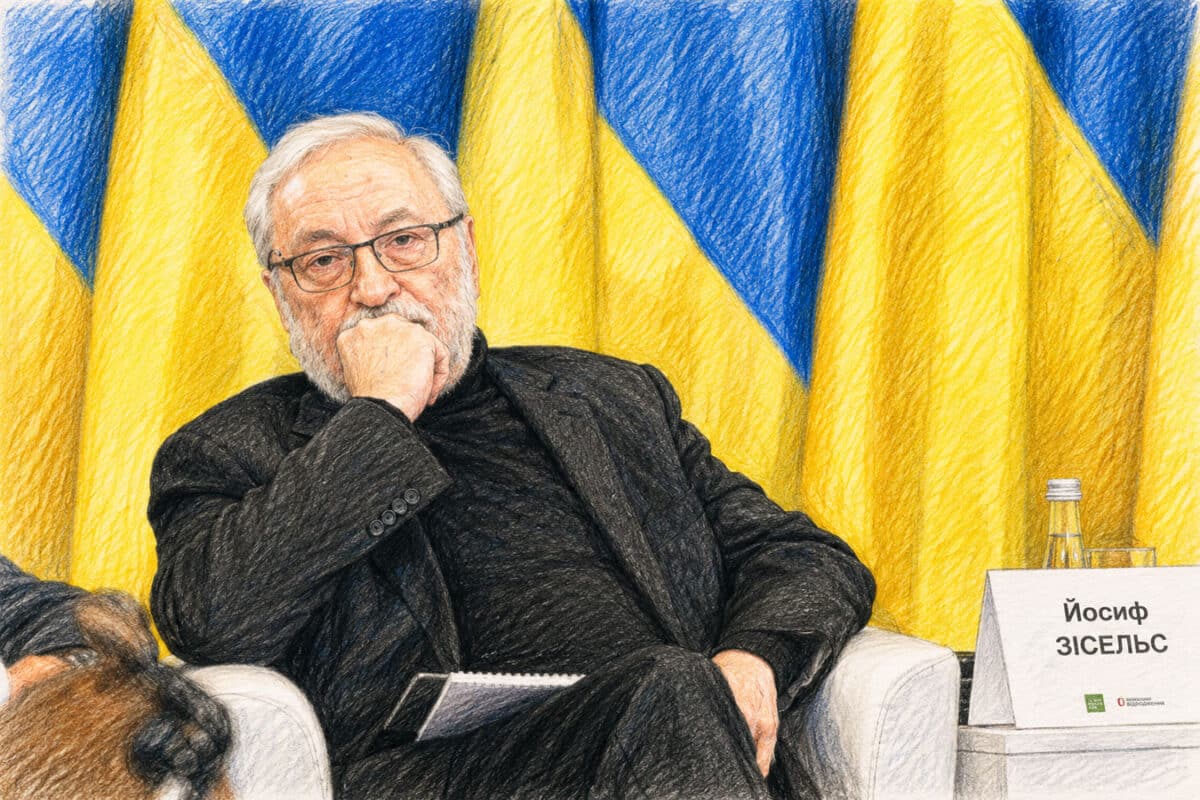
In the interview, Zisels begins with a topic that is especially important for the Israeli audience: identity.
He emphasizes that for him it is essential to say not just “Jew,” but “Ukrainian Jew”. Not because Jewish origin takes a back seat, but because around the Jewish core, a Ukrainian civic, linguistic, and cultural shell has formed.
For Israel, this is a very understandable topic.
Israeli society also consists of people with different roots: from Ukraine, Morocco, Poland, Iraq, Ethiopia, Russia, Yemen, France, Argentina. But when the question of the state’s existence arises, personal biography becomes part of a common destiny. This is what Zisels tries to explain to Ukraine: a state becomes strong not when it has a flag, anthem, and army, but when most citizens feel it as their own responsibility.
In this sense, his words about Ukrainian Jews sound broader than just a conversation about a national group. It’s a conversation about how a new political nation is born.
Zisels reminds that the Soviet system destroyed not only people but identities. It made Jews Russian-speaking, Ukrainians — “Soviet,” memory — convenient, history — manageable. Therefore, returning to Ukrainian identity for him is not a fashion or a slogan, but a long path of liberation from the empire.
The Soviet myth and the memory of the Holocaust
One of the strongest parts of the interview is the conversation about World War II, the Soviet army, and the Holocaust.
Zisels sharply argues against the usual formula that the Soviet Union “liberated the Jews.” His logic is this: the Soviet army fought against Nazi Germany, but saving Jews as Jews was never an announced goal of the Soviet authorities. Moreover, the very topic of the Holocaust in the USSR was pushed aside for decades, dissolved in the general formula of “peaceful Soviet citizens” and was almost not recognized as a separate tragedy of the Jewish people.
For the Israeli reader, this is especially important.
In Israel, the memory of the Holocaust is part of the national foundation. In the post-Soviet space, it was long replaced by another memory: not about specific destroyed communities, not about Babi Yar, not about millions of Jews in Eastern Europe, but about an impersonal Soviet victory, where the empire appropriated the moral right to speak on behalf of all victims.
Zisels destroys precisely this myth.
He also speaks about modern Ukraine: in his assessment, the level of anti-Semitism in the country today is one of the lowest in Europe, and the path to true Europeanness lies not through demonstrative laws and political gestures, but through education, culture, the rule of law, and an honest conversation about the past.
This is an important point. According to him, Ukraine will not become European just because it adopts the right documents. Europeanness is not paper. It’s a habit of freedom, responsibility, law, and dignity.
30% who stopped Russia
The main figure of the interview is 30%.
Zisels says that it is these people who are holding the country today. They fight, volunteer, donate, heal, evacuate, repair, teach, write, transport, collect, help the army and refugees. They do not expect the state to do everything for them because they themselves feel part of the state.
And here the main paradox appears.
According to Zisels, these 30% were enough to stop Russia. This is a huge historical result. But for a long war, for victory, for recovery, and for a sustainable future, this may not be enough.
NANews — Israel News | Nikk.Agency often writes about Ukraine precisely through the Israeli lens: not as a distant country on the map, but as a state where the question of survival has become a daily reality. And therefore, the comparison of Zisels with Israel here is not accidental.
He says that a true national consensus begins when 75–80% of citizens are ready to limit themselves and sacrifice for their country. In Israel, in his assessment, such a level of consensus exists: despite all internal conflicts, elections, protests, disagreements, and political fatigue, the majority understands that when the existence of the state is threatened, it is necessary to act together.
Ukraine still needs to reach this level.
But there is something else important: Zisels does not belittle Ukraine with this assessment. On the contrary, he says that 30% is a lot. For 35 years of independence, the country has for the first time received such a share of people for whom Ukraine has become not just a place of residence, but an internal value.
So this is not a diagnosis of defeat. It’s a diagnosis of maturation.
50% silence — the hardest part of the war
The most unpleasant part of the interview is not about the pro-Russian 20%.
With them, at least, everything is clear. If a person breaks the law — there is the Criminal Code. If he simply carries old imperial loyalty, education, culture, environment, time, and public pressure work with this.
It’s more complicated with others — with those very 50%.
Zisels talks about people who can be good specialists, educated, smart, successful, outwardly normal citizens. But Ukraine has not yet become a personal value for them. They can live in the country, use its opportunities, criticize the authorities, discuss the news, but not feel that victory depends on them too.
This is not always betrayal. More often — indifference.
And indifference in a long war becomes a separate front. Not as noticeable as the line of combat contact, but very dangerous. Because the army can hold the front, volunteers can close gaps, medics can save the wounded, but the state cannot survive indefinitely on the efforts of a minority.
In Israel, this is understood especially acutely.
Here, too, there are disputes, fatigue, anger at the authorities, disappointment, political splits. But there is a basic boundary: when the question concerns the existence of the country, the majority understands that personal comfort cannot be above the survival of the state.
Ukraine, if following Zisels’ logic, needs to go precisely this path — from emotional patriotism to mature responsibility.
The war is long, and this must be said honestly
Zisels says another thing that politicians usually avoid saying: the war with Russia will not end quickly in a historical sense.
Even if a truce comes, even if hostilities stop, even if a diplomatic formula appears, the problem itself will not disappear. Russia was, is, and will be Ukraine’s neighbor for a long time. And the Russian imperial idea, according to Zisels, has not died and will not disappear by itself.
This is a very important warning.
Ukraine cannot build a future on the illusion that one day everything will “return as it was.” It won’t. After 2014, it didn’t return. After 2022, it certainly won’t return.
So, it is necessary to prepare not only the army but also society. Children, schools, universities, culture, media, communities, business, local self-government. It is necessary to cultivate not fear of war, but an understanding of responsibility for the country.
And here Zisels again sounds almost Israeli.
Israel was built on the understanding that security is not a separate profession of the military, but part of national existence. This does not mean that society should live only by war. But it should understand the price of freedom.
Why this is important for Israel
For Israelis of Ukrainian origin, this interview sounds especially personal.
Many in Israel know well the Soviet system, the Russian-speaking environment, old imperial myths, the habit of talking about freedom but not taking responsibility for the state. Many see how Russian propaganda still works among immigrants from the former USSR, including in Israel. And therefore, Zisels’ words are not only about Ukraine.
They are about us too.
About how to distinguish memory from propaganda.
About why Jewish history in Ukraine is not reduced to the Soviet myth.
About why Ukraine and Israel can understand each other better than it seems at the level of official diplomacy.
About why national consensus does not arise from slogans, but grows from culture, education, and readiness to pay the price.
Zisels says unpleasant things. But it is precisely unpleasant things that are sometimes needed by a society that wants to survive.
Ukraine has already proven that 30% of strong, free, and responsible citizens can stop an empire.
Now the main question is different: can it make it so that these people become not 30%, but the majority.
And then Russia will face not just the Ukrainian army. It will face a mature Ukrainian nation.